What Export L/C Workability Means, and Why Compliant Is Not the Same as Workable
The best time to fix an unworkable letter of credit is before you accept it.
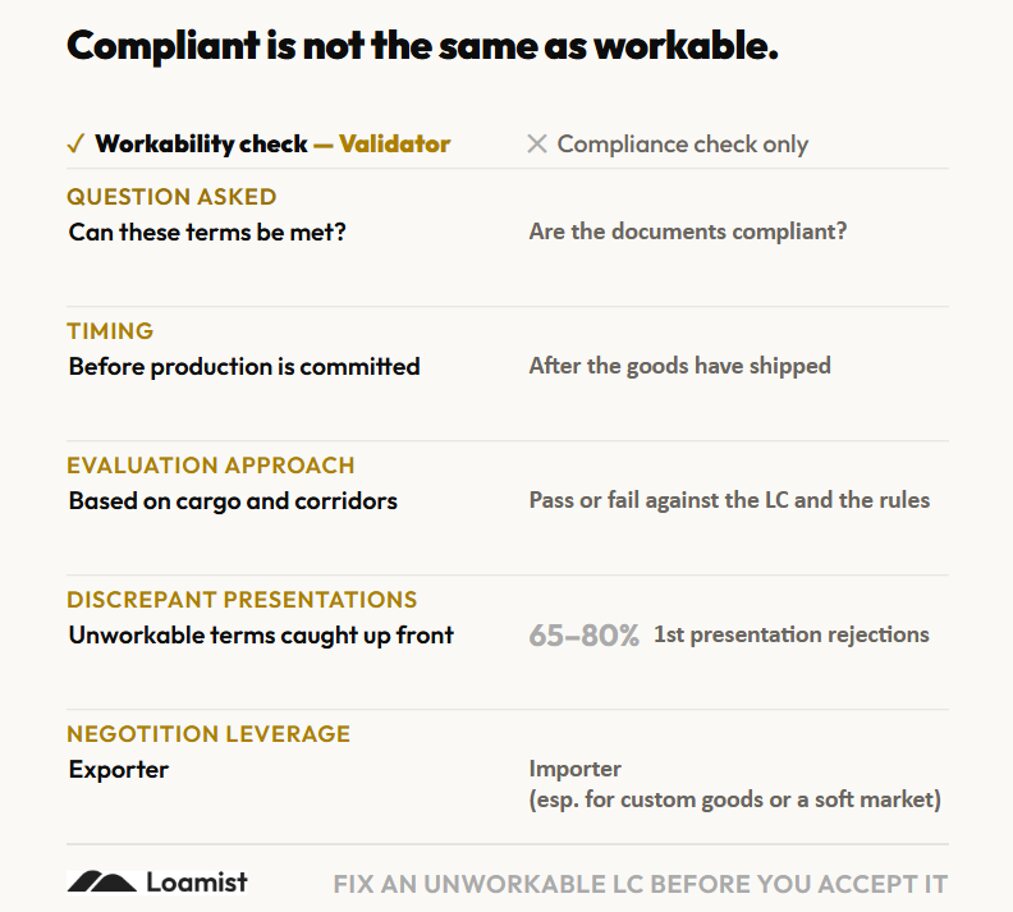
A workability check is the first step in the export L/C review process. It answers one question: can these terms actually be met, given this cargo, this corridor and this shipment window, before production is committed? A tight latest-shipment date, a conflicting clause, or a document requirement no one can satisfy is far cheaper to catch now than after the goods have shipped.
The cost of getting it wrong is measurable
Roughly 65% to 80% of documentary presentations under letters of credit are rejected on first submission for discrepancies, and each rejection carries fees, delays and payment risk. Many of those discrepancies trace back to terms that were never workable in the first place. The documents did not fail. The credit asked for something the shipment could not deliver.
Uncurable discrepancies are the real exposure
A workability check also reduces the risk of uncurable discrepancies: late shipment, an expired credit, and quantity or goods mismatches. You cannot correct these after the fact. Once a discrepancy is uncurable, the issuing bank is no longer obligated to pay, and the letter of credit becomes a commercial renegotiation rather than a bank-payment instrument.
If the L/C was confirmed, that confirmation fee is now wasted, because an uncurable discrepancy turns the transaction into an open-account sale. The applicant holds the leverage. In our analysis, the exporter's exposure can range from a single-digit percentage to a substantial share of the L/C value, depending on cargo control and resale economics. Custom-manufactured goods and a soft market are the worst case.
Compliant is not the same as workable
| Workability check | Compliance check only | |
|---|---|---|
| Question asked | Can these terms be met? | Are the documents compliant? |
| Timing | Before production is committed | After the goods have shipped |
| Evaluation approach | Based on cargo and corridors | Pass or fail against the L/C and the rules |
| Discrepant presentations | Unworkable terms caught up front | 65% to 80% first-presentation rejections |
| Negotiation leverage | Exporter | Importer, especially for custom goods or a soft market |
Workability is most useful when it is intelligent
A generic pass or fail against the rules will tell you the credit is internally consistent. It will not tell you whether your plant can make the latest shipment date, whether your carrier serves the named port on that routing, or whether the inspection agency in the loading port will sign the certificate as worded. Validator learns an exporter's real capabilities from prior shipments. It gives recommendations tuned to the specific cargo types and trade corridors that exporter actually runs: not a generic verdict, but a read on whether this exporter can meet these terms.
In one engagement, Validator achieved 99% client-specific workability accuracy by learning from four months of the exporter's historical transactions. The rules were the same as everyone else's. The judgement about what this company could deliver was the part that had to be learned.
Key takeaways
- Workability asks whether the credit can be met; compliance asks whether documents match it. Only the first question can be asked before shipment.
- Uncurable discrepancies remove the bank's obligation to pay and waste any confirmation fee.
- A workability check earns its keep when it knows your cargo and corridors, not just the rulebook.
The best time to fix an unworkable L/C is before you accept it. Try Validator's free workability check, no credit card required, or contact us to see the 99% result on your own credits.
Frequently asked questions
What is an LC workability check?
A review of a letter of credit's terms, done when the credit arrives, to confirm they can be met with the actual cargo, corridor and shipment window before production is committed. It looks for deadlines, documents and clauses that cannot be satisfied as drafted.
How is workability different from compliance checking?
Compliance checking asks whether finished documents comply with the credit, after shipment. Workability asks whether the credit itself can be complied with, before anything is produced or shipped.
What happens if a discrepancy cannot be cured?
The issuing bank is no longer obliged to pay. Payment depends on the applicant waiving the discrepancy, which turns the credit into a commercial negotiation, and any confirmation fee paid is wasted.
See 99% client-specific workability accuracy on your credits
Validator reached 99% client-specific workability accuracy by learning from four months of one exporter's historical transactions. Contact us to see how it reads your credits, or try the free check now.
Run a free workability check on a recent L/C, or book a demo and we will walk through a live decision trace.

Nick works with exporters and trade-finance teams on letter-of-credit operations, and writes about how documentary credits fail in practice and what it takes to present clean the first time. Connect with Nick on LinkedIn, or follow Loamist for the short version of each post.