Clean at the Source: Generate L/C Documents From the Credit Instead of Fixing Them Later
The cheapest L/C discrepancy is the one that never gets typed.
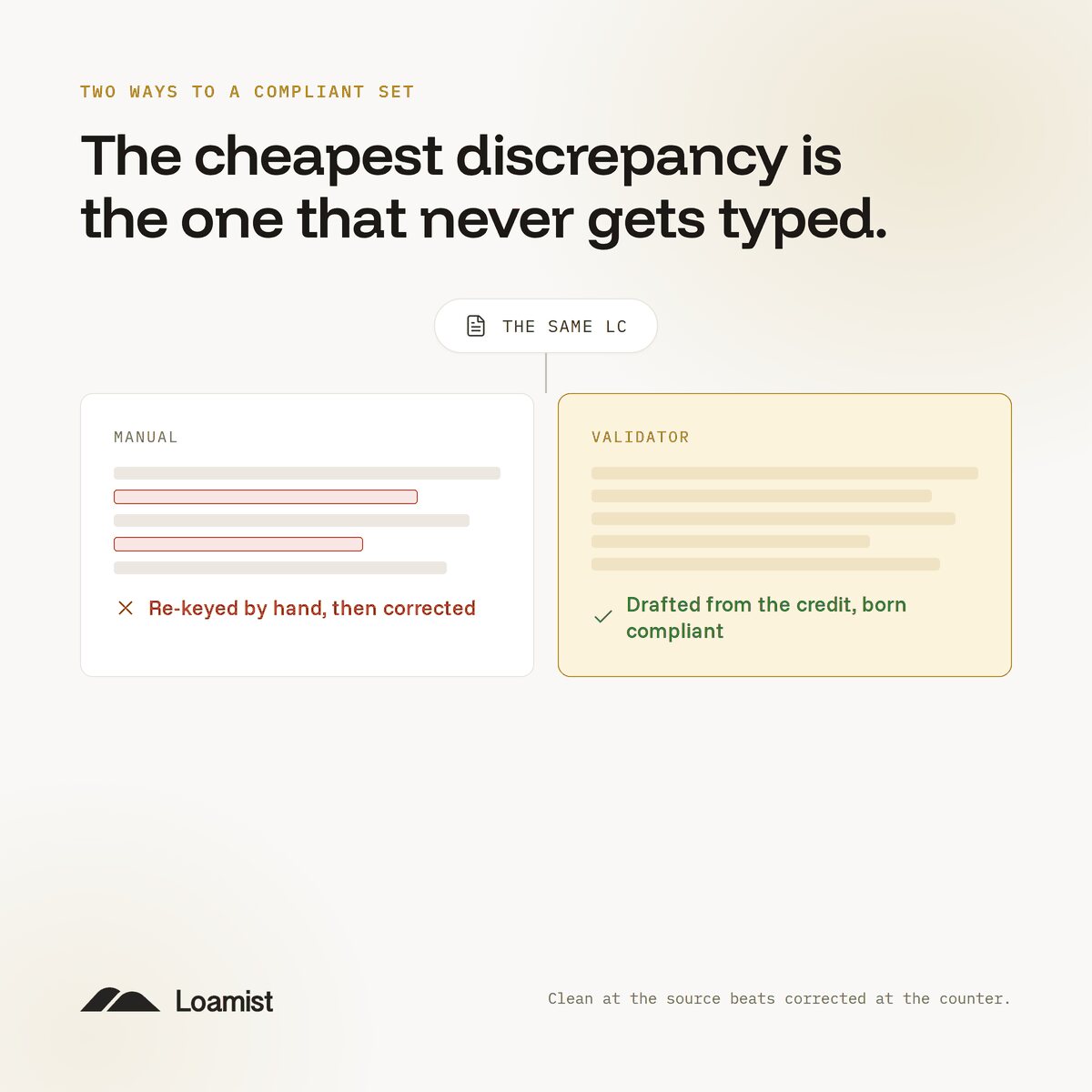
The cheapest L/C discrepancy is the one that never gets typed.
There are two ways to create a compliant document set. One: prepare the documents, check them, and fix what is wrong. Two: generate the documents from the L/C itself, so they start as compliant in the first place. Most of the industry does the first.
Re-keying is the discrepancy factory
Every invoice, packing list, transport document and certificate includes data the L/C already specifies. The goods description in field 45A. The applicant's name and address in 50. The ports in 44E and 44F. The credit number itself, which most credits require on every document. Re-keying that data by hand, into templates that were built for a different credit, is what creates discrepancies. The information was correct in the credit. It became wrong in the copying.
A typical export document set carries the same twenty or thirty data points across five or six documents. That is well over a hundred manual transcriptions per presentation, each of which a bank examiner will compare against the credit and against each other.
Generate, do not transcribe
Loamist Validator drafts your own documents from the credit's requirements: the commercial invoice, the packing list, the beneficiary's certificates and declarations. The goods description is the credit's goods description. The consignee is the party the credit names. The credit number is populated, not typed. Where the credit has a quirk, such as a specific certification wording or a required reference, the generated document carries it because the credit did.
For documents you do not issue yourself, Validator creates detailed instructions for the third party. (The ICC Banking Commission's Technical Advisory Briefing No. 16 sets out how third-party documents are examined and accepted under UCP 600, which is the standard those instructions are written to.) The carrier gets the exact notify party, port names and marks the bill of lading must show. The inspection agency gets the certificate wording the credit demands, so it is issued right rather than reissued later. Then Validator pre-checks the complete set, your documents and theirs, before presentation.
Cheaper and faster, not just cleaner
Getting the documents right at the source is cheaper and faster than fixing them later. A generated invoice takes seconds and needs no second pass. A hand-prepared invoice takes an hour, then another hour of checking, then a courier if the checking missed something. The compliance benefit is real, but the throughput benefit is what documentation teams notice first.
Where the credit's data ends up
A useful exercise is to take one L/C and count the destinations of each field. The goods description in field 45A appears on the commercial invoice, usually on the packing list, often on the certificate of origin and sometimes on the insurance document. The credit number appears on every document. The applicant's name and address appear on the invoice and the transport document's consignee or notify block. Ports and the latest shipment date govern the transport document. A credit with thirty data points can easily generate over a hundred placements across the set, and under UCP 600 article 14(d) every one of them is compared with the credit and with every other placement. Generation from the credit collapses that hundred to one: the value is right in the credit, so it is right everywhere it lands.
Key takeaways
- Most document discrepancies are transcription errors of data the credit already contains.
- Generating documents from the credit removes the transcription step, and with it most of the errors.
- Third-party documents cannot be generated, but they can be instructed precisely, which is the next best thing.
For the fields a compliant invoice must carry, and the ways they usually go wrong, see how to prepare a compliant commercial invoice under a letter of credit.
See Validator on one of your own letters of credit
Loamist Validator reads an export L/C the day it arrives, flags the terms that cannot be met, drafts the documents from the credit, and pre-checks the full set against UCP 600, eUCP and ISBP 821E before the bank sees it.
Run a free workability check on a recent L/C, or book a demo and we will walk through a live decision trace.

Nick works with exporters and trade-finance teams on letter-of-credit operations, and writes about how documentary credits fail in practice and what it takes to present clean the first time. Connect with Nick on LinkedIn, or follow Loamist for the short version of each post.