What Is an Export Letter of Credit? A Plain-English Explainer
A letter of credit is a bank's promise to pay an exporter against documents, not against cargo. That one fact explains almost everything about how L/Cs behave.
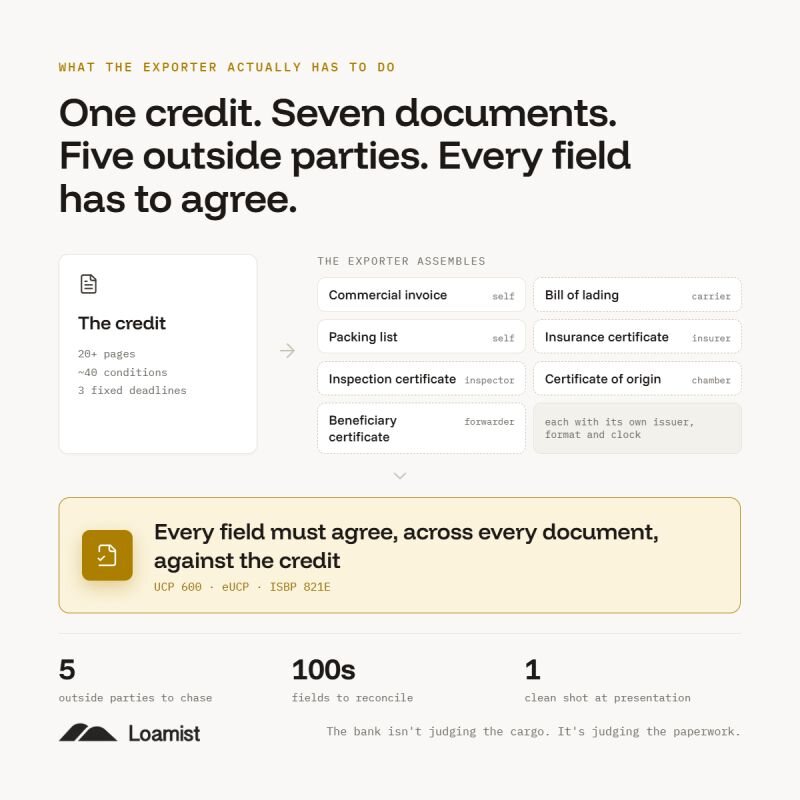
An export letter of credit (L/C), in simple terms, is a promise by a bank, called the issuing bank, to pay an exporter on behalf of a buyer. The bank guarantees payment when the exporter provides documents proving that the agreed shipment was fulfilled. That is the whole instrument. Everything else in the trade-finance vocabulary, from UCP 600 to discrepancy fees, follows from it.
How an export L/C works, step by step
- The buyer applies for the credit. The buyer's bank (the issuing bank) opens a letter of credit in the exporter's favour, usually by SWIFT MT700, and sends it through a bank in the exporter's country (the advising bank).
- The exporter checks the terms. Before committing production, the exporter confirms the credit can actually be met: shipment dates, ports, goods description, and the list of required documents. We call this a workability check.
- The exporter ships and prepares documents. Each export L/C has its own list. Generally, commercial invoices, transport documents, packing lists, insurance and inspection or other certificates are required.
- The exporter presents. The documents go to the nominated or confirming bank within the presentation period, and before the credit expires.
- The bank examines and pays. If the documents exactly meet the letter of credit terms, the bank pays the exporter and forwards the documents to the buyer, who needs them to collect the cargo.
Trust in a bank, and in documents
An export L/C substitutes trust in the buyer with trust in a bank and a set of documents. A seller in one country can be paid for goods sold to a buyer in another country, and the buyer can receive the goods, without either party taking the other's word for it. The bank stands in the middle and deals only in paper.
This explains why letter of credit terms are so strict. The bank does not examine the cargo. It determines whether the documents meet the L/C requirements, line by line. UCP 600, the ICC rules that govern most credits, says it directly: banks deal with documents and not with the goods, services or performance to which the documents may relate.
Why "exactly" is the operative word
Because the bank cannot look at the shipment, it has nothing to go on except the consistency of the documents with the credit and with each other. A vessel name spelled two ways, an invoice amount that exceeds the credit by a few dollars, or a certificate dated after the shipment date are not clerical trivia to a document checker. They are the only evidence available, and if the evidence conflicts, the presentation is refused.
The ICC Banking Commission has put first-presentation refusal rates between 65% and 80% for years (Technical Advisory Briefing No. 3, 2022). Most of those refusals are not fraud or failed shipments. They are ordinary documents that do not match an ordinary credit, produced under time pressure by people re-keying the same data three or four times.
Where exporters get hurt
- Unworkable terms accepted at the start. A latest shipment date the plant cannot hit, or a certificate no inspector in the corridor issues, guarantees a discrepancy before a single document exists.
- Discrepancies found at the bank. Each refusal carries a fee, a delay of days to weeks, and a courier loop. Payment can slip 30 to 45 days on cargo that has already sailed.
- Discrepancies that cannot be cured. Once a shipment date or expiry has passed, no correction restores compliance. Payment then depends on the buyer agreeing to waive, which turns a bank instrument back into a negotiation.
Key takeaways
- An export L/C is a bank's undertaking to pay against complying documents, not against goods.
- Strictness is structural: documents are the only evidence the bank has.
- Most refusals come from mismatches between documents and the credit, and many of those trace back to terms that were never workable.
Over the coming weeks we will take each stage in turn: what workability means, what a rejected presentation actually costs, and how document generation from the credit itself removes most of the re-keying that creates discrepancies in the first place. If you want a head start, the pre-shipment L/C review guide is the practical version of this post.
Frequently asked questions
Who pays under an export letter of credit?
The issuing bank, on behalf of the buyer, once the exporter presents documents that comply with the credit's terms. A confirming bank may add its own undertaking to pay.
Does the bank inspect the goods?
No. Under UCP 600 banks deal with documents only. If the documents comply, the bank pays, whatever happened to the cargo.
What documents does an export L/C usually require?
Each credit lists its own set. Commercial invoice, transport document, packing list, insurance document and inspection or origin certificates are the usual core.
See Validator on one of your own letters of credit
Loamist Validator reads an export L/C the day it arrives, flags the terms that cannot be met, drafts the documents from the credit, and pre-checks the full set against UCP 600, eUCP and ISBP 821E before the bank sees it.
Run a free workability check on a recent L/C, or book a demo and we will walk through a live decision trace.

Nick works with exporters and trade-finance teams on letter-of-credit operations, and writes about how documentary credits fail in practice and what it takes to present clean the first time. Connect with Nick on LinkedIn, or follow Loamist for the short version of each post.