The Discrepancy Fee Is the Smallest Part of a Rejected L/C Presentation
The bank fee is what shows up on the statement. The real cost of a refused presentation is time, capital and leverage, and the worst cases cannot be fixed at any price.
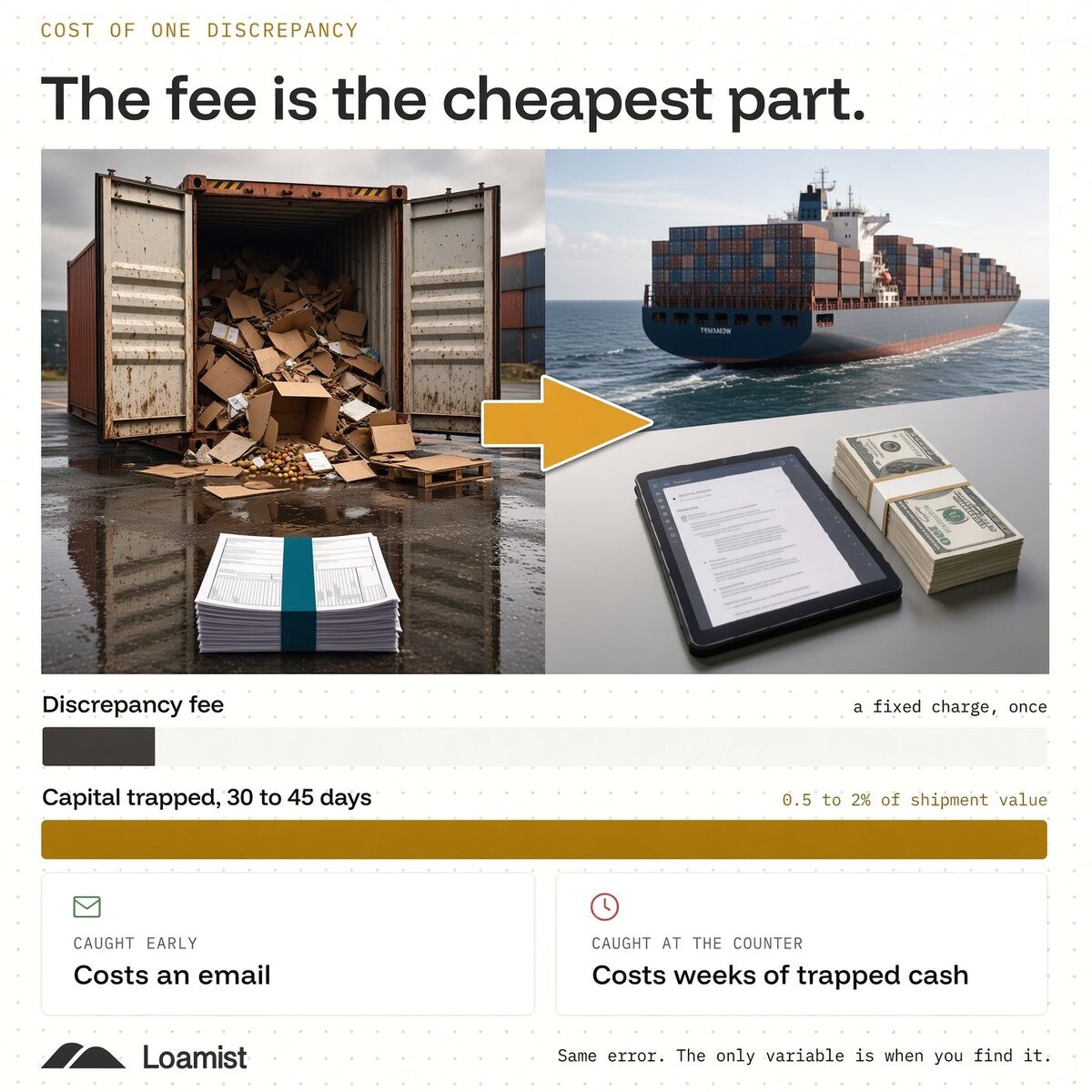
The discrepancy fee is the minor part of the total cost of a rejected presentation. The real costs are documents shipped back and forth, corrections, resubmissions, and payment delayed for up to 45 days. A single discrepant presentation can easily cost between 0.5% and 2% of the shipment's value. On thin-margin cargo, that can wipe out most of the profit.
Where the money actually goes
- Fees. USD 50 to 150 per discrepancy is typical, charged again on each re-presentation. Visible, but small.
- Rework. Someone has to find the error, get the document reissued (often by a third party in another time zone), and courier originals back to the bank.
- Time. Each loop adds days. Payment that should have landed at sight can slip 30 to 45 days on cargo that has already left the port.
- Working capital. That delay is financed by the exporter. At current rates, a month of carry on a seven-figure invoice is a meaningful number on its own.
- Leverage. A discrepant presentation hands the buyer a legitimate reason to delay payment or reopen the price.
The greater exposure: discrepancies that cannot be cured
Most discrepancies are curable. You correct the document, present again, pay the fee, absorb the delay. The dangerous category is the one where no correction can restore compliance. Once a latest shipment date has passed, a presentation period has expired, or an original document cannot be reissued, the presentation is discrepant for good.
At that point payment depends entirely on the applicant's agreement to waive the discrepancies. If that decision is being made when the market has moved against the exporter, the loss can be much more than 2%. On perishable goods, or cargo manufactured to a single buyer's specification, the result can be a complete write-off. The letter of credit has quietly become an open-account sale, with the buyer holding the goods and the exporter holding the paperwork.
Why the industry tolerates it
The ICC estimates that between 65% and 80% of presentations are rejected on first submission (Technical Advisory Briefing No. 3). Most exporters treat that as the price of doing L/C business. It is not. It is the price of catching problems too late. A problem spotted while the L/C is being negotiated costs an email to the buyer. The same problem at presentation costs a fee, a fortnight, and a conversation you did not want to have.
Moving the catch point earlier
Loamist Validator is designed around that timing. It drafts L/C terms from purchase orders and commercial contracts before the credit is opened, performs a workability analysis the moment an L/C arrives, generates the documents from the credit so they start compliant, and runs a full pre-check before anything goes to the bank. Each stage moves the moment of discovery to a point where fixing the problem is still cheap.
Key takeaways
- Budget 0.5% to 2% of shipment value for a discrepant presentation, not the fee.
- Uncurable discrepancies convert a bank undertaking into a buyer's option to pay.
- The cost of a fix rises with every stage; the day the L/C arrives is the cheapest day to find it.
For the specific defects behind most refusals, and how to stop each one, see our guide to the top 10 letter of credit discrepancies.
Frequently asked questions
How much is a typical LC discrepancy fee?
Banks commonly charge USD 50 to 150 per discrepancy, and again on every re-presentation. The fee is small relative to the delay and capital cost it signals.
What is an uncurable discrepancy?
A defect no corrected document can fix: the latest shipment date has passed, the presentation period or credit has expired, or an original document cannot be reissued. Payment then depends on the applicant waiving the discrepancy.
See Validator on one of your own letters of credit
Loamist Validator reads an export L/C the day it arrives, flags the terms that cannot be met, drafts the documents from the credit, and pre-checks the full set against UCP 600, eUCP and ISBP 821E before the bank sees it.
Run a free workability check on a recent L/C, or book a demo and we will walk through a live decision trace.

Nick works with exporters and trade-finance teams on letter-of-credit operations, and writes about how documentary credits fail in practice and what it takes to present clean the first time. Connect with Nick on LinkedIn, or follow Loamist for the short version of each post.