Two Out of Three Letters of Credit Fail on First Presentation. It Does Not Have to Be This Way.
If two out of three wire transfers failed, it would be a treasury emergency. In documentary trade, it is just another day.
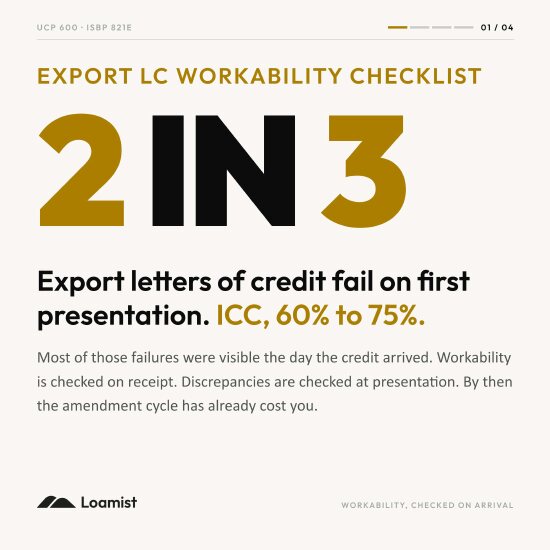
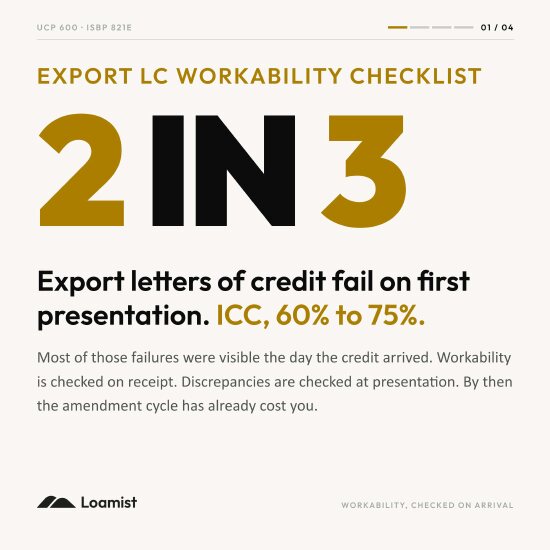
Two out of three letters of credit fail on first presentation. If two out of three wire transfers failed, it would be a treasury emergency. In documentary trade, it is just another day. The ICC puts first-presentation refusals at 65% to 80% (Technical Advisory Briefing No. 3, June 2022), and the figure has barely moved since UCP 600 took effect in 2007.
The strange part is the acceptance
Most exporters have made peace with it. Delays are expected and absorbed by working capital. Fees get paid without much argument. Rejection is treated as the normal outcome of a payment instrument whose entire purpose is certainty of payment. No other part of the finance function would tolerate a two-thirds failure rate on a routine process.
Why it does not have to be this way
Three things about a letter of credit are knowable in advance.
- The rules are public. UCP 600, eUCP and ISBP 821E are published documents. The standard the bank will apply is not a secret.
- The credit is based on your commercial agreement. The L/C in your hands should mirror the sales contract. Where it does not, you can see the conflict on day one.
- Your own history shows where things go wrong. The same corridors, the same document types, the same counterparties produce the same discrepancies. Past presentations are a map of future refusals.
Validator checks the full document set against exactly those three inputs: your transaction history, the credit's terms, and UCP 600, eUCP and ISBP 821E. Measured on live transactions, that reaches 99% pre-check accuracy. The first presentation should be the only one.
The workability checklist
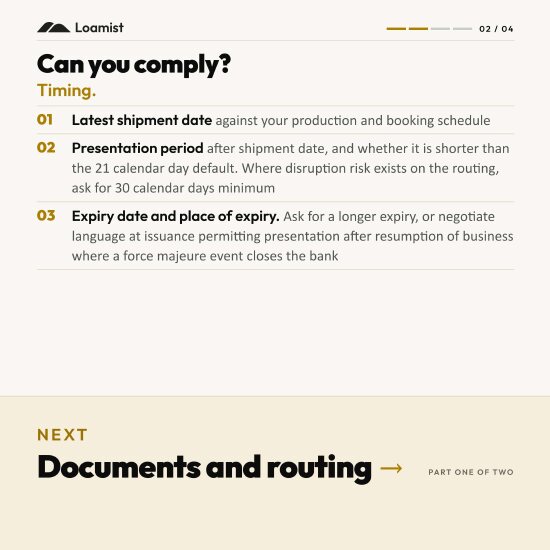
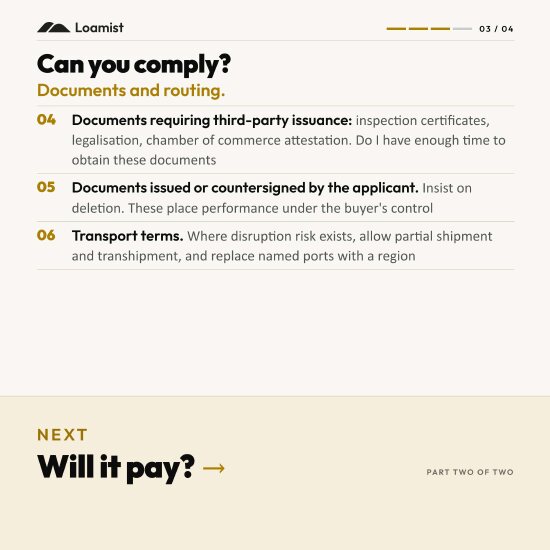
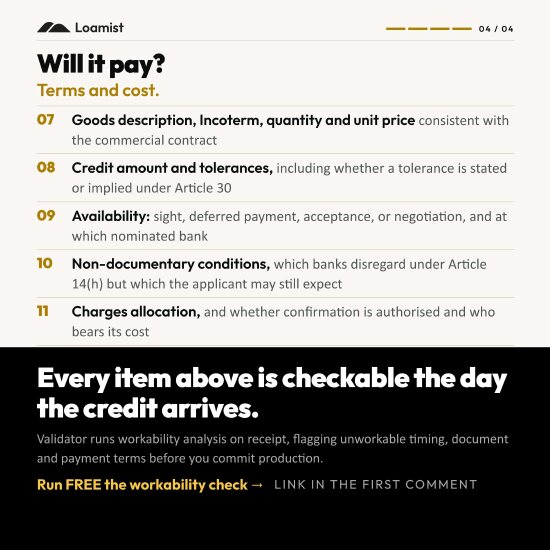
The carousel that went with this post on LinkedIn walks through the checks that catch most refusals before production starts. The slides are below, and you can download the carousel as a PDF.
What the failure rate costs a business
Put the ICC figure against a modest export book. An exporter presenting forty letters of credit a year at the low end of the range sees roughly twenty-five refused first time. Each refusal draws a discrepancy fee, a courier loop for corrected originals, and a payment delay that commonly runs 30 to 45 days on cargo already shipped. Finance carries that delay as working capital. Operations carries the rework. Sales carries the awkward conversation when a buyer uses the discrepancy to reopen the price. None of those costs appear on a single line, which is a large part of why the rate has been tolerated for so long: it is spread across three departments and never totalled.
The same arithmetic explains why the first presentation should be the only one. Cutting the refusal rate from two in three to one in ten does not save a fee. It returns weeks of cash flow and dozens of hours of skilled time across the year, and it removes the buyer's most reliable lever for renegotiation.
Run it on a real credit
Use the checklist on your next L/C, or skip the manual pass and try our free export workability check. Upload the credit and Validator returns the terms that cannot be met as drafted, with the rule behind each one. For the long-form version, our complete export L/C document checklist covers every document in the set.
See Validator on one of your own letters of credit
Loamist Validator reads an export L/C the day it arrives, flags the terms that cannot be met, drafts the documents from the credit, and pre-checks the full set against UCP 600, eUCP and ISBP 821E before the bank sees it.
Run a free workability check on a recent L/C, or book a demo and we will walk through a live decision trace.

Nick works with exporters and trade-finance teams on letter-of-credit operations, and writes about how documentary credits fail in practice and what it takes to present clean the first time. Connect with Nick on LinkedIn, or follow Loamist for the short version of each post.