
A Model Call Is Not an Examination System: the Engineering Behind High Accuracy at Low Cost
Accuracy and cost are not a trade-off you should accept.
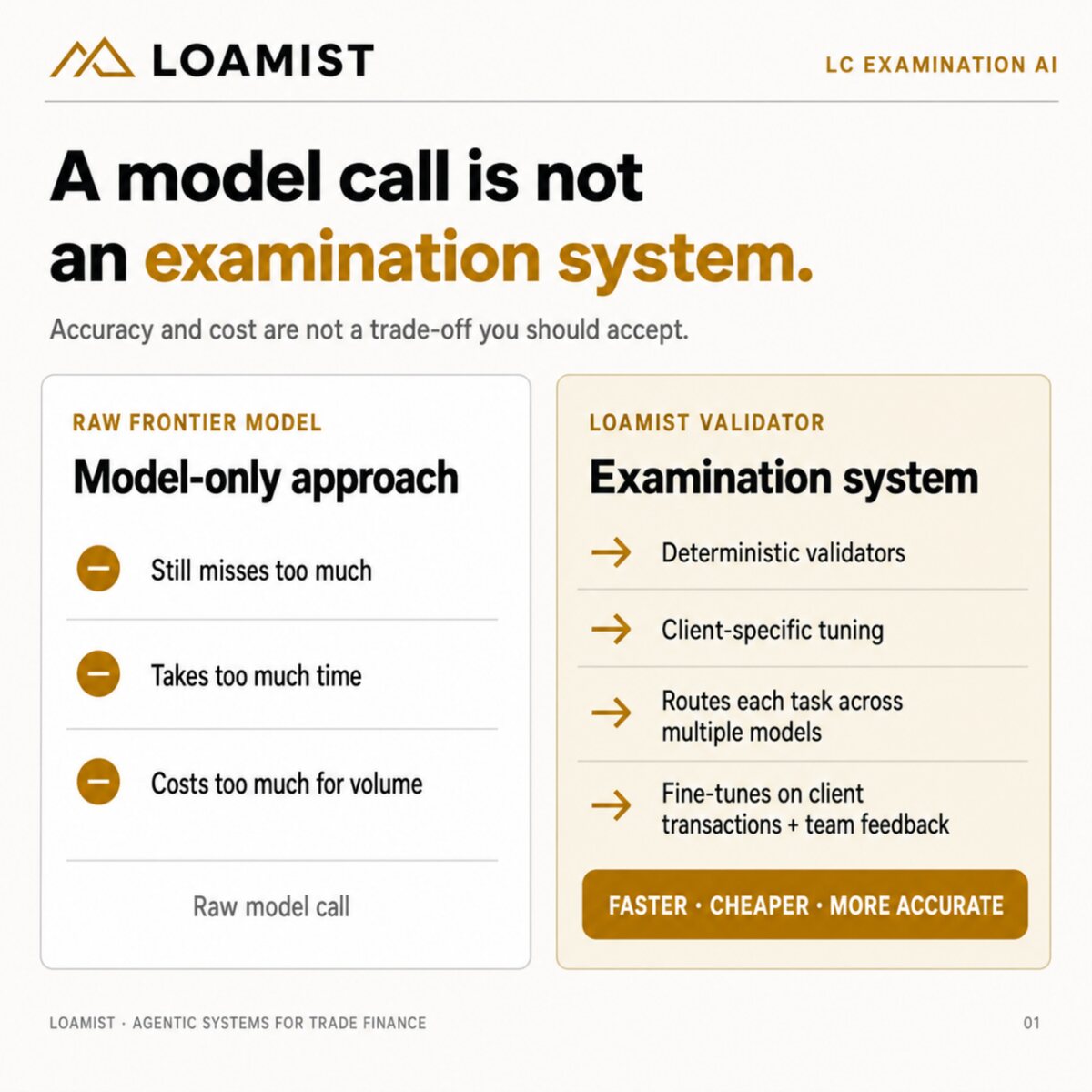
Push a frontier model to catch every discrepancy between documents and the L/C, and it still misses too much, takes too much time, and costs too much.
Loamist Validator's design solves all three. It is faster, cheaper and more accurate, and it gets there by treating the model as one component of an examination system rather than the system itself.
Why a raw model call falls short
- It misses too much. A general-purpose model reads a 40-page presentation the way a smart generalist would: well, but not with the mechanical rigour that catches a transposed digit on page 31 or a date that falls one day outside the presentation period.
- It takes too long. Large presentations, long contexts and multi-document cross-checks make a single monolithic call slow, and slow examination is expensive examination when a deadline is measured in days.
- It costs too much for volume. Sending every page of every presentation through the largest available model on every check does not scale to a documentation team's monthly volume.
What sits around the model
Deterministic validators. Dates, amounts, tolerances, presentation periods, cross-document identifier matches: these are rules, and rules should be checked by code that gives the same answer every time. The model is not asked to count days.
Multi-model routing. Each task routes across multiple models, so the right model handles the right step. Extraction, classification, comparison and explanation have different accuracy and cost profiles; using one frontier model for all of them is paying for capability most steps do not need.
Client-specific tuning. Validator constantly fine-tunes on the client's transactions and the documentation team's feedback, to reach examination accuracy well beyond what a general-purpose model can. The rulebook is public; the judgment about this exporter's corridors and counterparties is learned, and it keeps being learned as the team corrects and confirms findings.
The result
Faster, because the mechanical checks are instant and the model is only asked the questions that need a model. Cheaper, because routing puts the expensive capability where it earns its keep. More accurate, because deterministic checks do not drift and client tuning captures what no public model knows. Accuracy and cost are not a trade-off you should accept.
Key takeaways
- A general-purpose model alone misses too much, is too slow and costs too much for L/C examination at volume.
- Deterministic validators, multi-model routing and client-specific fine-tuning are what turn a model into an examination system.
- The combination is faster, cheaper and more accurate than the raw model, not a compromise between them.
Message us to see how Loamist can save you time and money, even on a few presentations per month: book a demo.
Frequently asked questions
Why not just use a frontier LLM to check L/C documents?
On its own a general-purpose model misses too many discrepancies, is slow on 40-page presentations, and is expensive at volume. Examination needs deterministic checks for the mechanical rules, routing so each step uses the right model, and tuning to the client's own transactions.
What does client-specific fine-tuning add?
Examination accuracy well beyond a general-purpose model, because most of what a checker knows about a corridor or counterparty is not in any public rulebook. Validator learns it from the client's transactions and the documentation team's feedback, continuously.
Save time and money, even on a few presentations a month
Message us to see how Validator's examination system performs on your credits: accuracy, turnaround and cost per presentation, measured on live transactions.
Run a free workability check on a recent L/C, or book a demo and we will walk through a live decision trace.

Nick works with exporters and trade-finance teams on letter-of-credit operations, and writes about how documentary credits fail in practice and what it takes to present clean the first time. Connect with Nick on LinkedIn, or follow Loamist for the short version of each post.