Client Logic, Fenced and Owned: Whose Data Is It, and Where Does It Go?
The most common objection we hear is about client data. Here is the architectural answer.
The most common objection we hear is about client data. Whose is it, and where does it go?
Three layers of knowledge
Validator's examination knowledge has three layers, and it matters which is which.
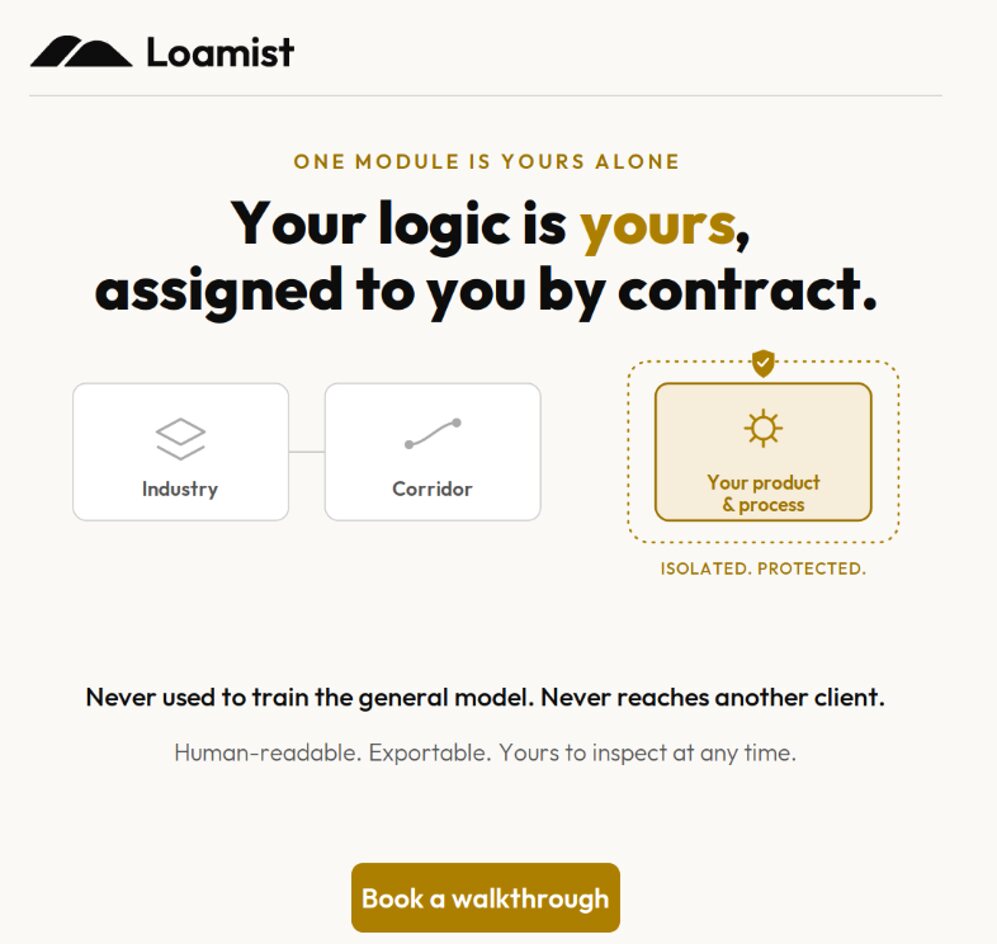
- Industry. UCP 600, eUCP, ISBP 821E, and the general practice of documentary credit examination. Public, shared, and the same for every client.
- Corridor. How specific ports, carriers, inspection agencies and issuing banks behave. Learned across the market and shared where it is general knowledge.
- Your product and process. Your goods descriptions, your counterparties, your document suppliers, the examination standards your team applies, and the patterns in your own presentations. This layer is yours alone.
Fenced by architecture, owned by contract
The logic Validator learns from a client, such as corridor rules, counterparty patterns and examination standards, is legally assigned to that client as their IP. It is never used to train the general model. It never reaches another client. We made that choice deliberately and built it into Loamist's foundational architecture: the isolation is a property of how the system is constructed, not a policy layered on afterwards.
The ownership is contractual. Your logic is yours, assigned to you by contract. If the relationship ends, it goes with you.
Human-readable, exportable, inspectable
We also store client logic in a human-readable format that the client can export and inspect at any time. The logic is not locked inside a black box, or inside model weights nobody can read. It is transparent and readily accessible. A documentation manager can open it and see, in plain language, what Validator believes about their corridors and counterparties, and correct it where it is wrong.
That transparency is also what makes the ownership meaningful. IP you cannot read is a legal abstraction. IP you can export and audit is an asset.
What this means in a procurement conversation
The questions come in a predictable order, and the answers are short. Is our data used to train your model? No: logic learned from your transactions never reaches the general model or another client. Who owns what the system learns? You do, by contract, as your IP. Can we see it? Yes, in a human-readable format you can export at any time. Can we take it with us? Yes; if the relationship ends, your logic goes with you. Is the isolation a policy or a design? A design: the boundary is a property of the architecture, and Validator is SOC 2 certified, so the controls around it are independently audited rather than asserted.
The reason we can answer that quickly is that we settled the questions before writing the first line of the learning layer. Corridor rules, counterparty patterns and examination standards are the most commercially sensitive thing an exporter's documentation team knows. A vendor that treats them as training data is asking to be paid in the customer's competitive advantage. We would rather be paid in subscription fees.
Key takeaways
- Industry and corridor knowledge is shared; product and process logic is isolated per client.
- Client logic is assigned to the client as IP by contract and never trains the general model.
- It is stored in a human-readable, exportable format the client can inspect at any time.
See how Loamist fences and owns client logic by design: book a walkthrough.
Frequently asked questions
Is our transaction data used to train Loamist's general model?
No. Logic learned from a client's transactions is legally assigned to that client as their IP, is never used to train the general model, and never reaches another client.
Can we see what Validator has learned about us?
Yes. Client logic is stored in a human-readable format that the client can export and inspect at any time.
See how Loamist fences and owns client logic by design
Book a walkthrough and we will show the isolation boundary, the human-readable export of your own logic, and the contract language that assigns it to you.
Run a free workability check on a recent L/C, or book a demo and we will walk through a live decision trace.

Nick works with exporters and trade-finance teams on letter-of-credit operations, and writes about how documentary credits fail in practice and what it takes to present clean the first time. Connect with Nick on LinkedIn, or follow Loamist for the short version of each post.