The Specialist Who Clears Your Export Documents Is Close to Retirement
The rules of documentary credit are stable. The people who can apply them to changing shipping conditions are not. Institutional knowledge should not depend on who is still at the desk.
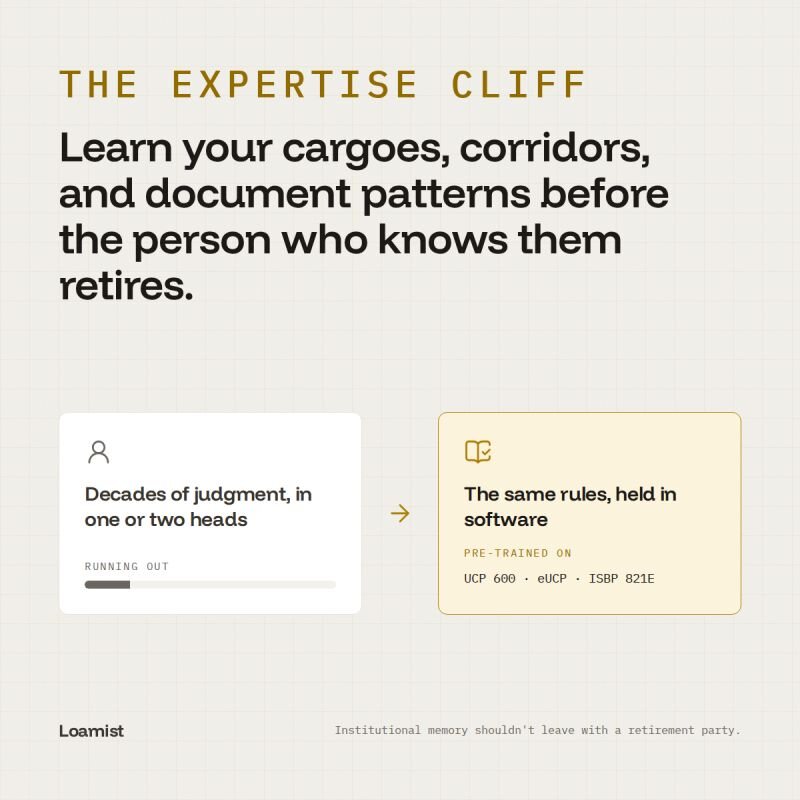
Every exporter has one. A document specialist who can read a 20-page letter of credit and identify which line will trigger a refusal. That judgment takes decades to build. One or two people in the business hold it, and they are leaving the workforce faster than they are being replaced.
The numbers have not moved
The ICC Banking Commission estimates that between 65% and 80% of documents are refused on first presentation under documentary credits (Technical Advisory Briefing No. 3, 27 June 2022). The Commission's full series of briefings is free to read and worth a bookmark for any documentation team. That rate has not fallen since UCP 600 took effect in 2007. Refusal does not usually stop payment, but it adds delay, discrepancy fees, rework on every affected shipment and occasional renegotiation.
Read those two facts together. The rules are stable and public. The failure rate is stable and high. The variable is the human capacity to apply the rules, correctly, under time pressure, to whatever the shipping market is doing this month.
What the specialist actually knows
The retiring examiner is not valuable because they have memorised UCP 600. They are valuable because they know things that are nowhere in the rules:
- Which inspection agency in a given port will refuse to sign a certificate worded the way this credit demands.
- How a particular issuing bank reads "shipping marks as per invoice" when the packing list disagrees.
- Which carriers routinely misstate the port of loading on a transhipment routing, and how to word the instruction so they do not.
- What went wrong on this buyer's last three credits, and which clause caused it.
That knowledge is learned from transactions, not textbooks. When the person leaves, it leaves with them. The next hire inherits the checklists and none of the judgment.
Holding examination knowledge in software
Validator is our answer to that problem. It holds the examination knowledge in software. It is pre-trained on UCP 600, eUCP and ISBP 821E, so the public part of the job is covered from day one. Then it learns each client's cargoes, corridors and recurring document patterns from their own transaction history, which is the part that used to live in one person's head. It has been tested across thousands of L/C examinations, and each finding is traced back to the rule or the client practice it relied on, so a less experienced checker can verify it rather than take it on trust.
None of this removes the need for an experienced examiner. It changes what they spend their day on. Routine review is handled; the specialist's time goes to exceptions, difficult corridors, and teaching the system the judgement calls that still need a person.
Key takeaways
- Refusal rates of 65% to 80% have not improved in nearly two decades of stable rules.
- The scarce asset is applied judgment about corridors, counterparties and documents, not knowledge of UCP 600 itself.
- That judgment can be captured from transaction history and kept in the business when people move on.
If your documentation team is one retirement away from a capacity problem, book a demo and we will show how Validator learns a corridor from your past presentations.
Frequently asked questions
What does the ICC say about first-presentation refusal rates?
The ICC Banking Commission's Technical Advisory Briefing No. 3 (27 June 2022), Reducing discrepancy rates under Documentary Credits, estimates that between 65% and 80% of documents are refused on first presentation under documentary credits.
Does refusal mean the exporter is not paid?
Usually not. Most refusals are cured and paid later. Refusal adds delay, discrepancy fees, rework on every affected shipment, and occasionally renegotiation.
See Validator on one of your own letters of credit
Loamist Validator reads an export L/C the day it arrives, flags the terms that cannot be met, drafts the documents from the credit, and pre-checks the full set against UCP 600, eUCP and ISBP 821E before the bank sees it.
Run a free workability check on a recent L/C, or book a demo and we will walk through a live decision trace.

Nick works with exporters and trade-finance teams on letter-of-credit operations, and writes about how documentary credits fail in practice and what it takes to present clean the first time. Connect with Nick on LinkedIn, or follow Loamist for the short version of each post.